How to Get Rid of Cat Pee Smell
If you have already tried cleaning a cat pee stain and the smell came back, you are not imagining it. Cat urine contains a compound that most household cleaners cannot break down. Here is what actually works, surface by surface, with the chemistry that explains why.
Time to read
7 min
Sections
7 + FAQ
When you buy through our links, we may earn a commission at no extra cost to you. That never changes what we recommend.
Why cat pee smells so bad and keeps coming back
Cat urine is not just ammonia. It contains felinine, a sulfur-based amino acid that only cats produce. When bacteria break down urine, they release thiols. Those are the same compounds in skunk spray. That is why cat pee smells worse than dog pee or human urine.
But the real problem is uric acid. Uric acid is not water-soluble. It bonds to whatever surface the urine touches and forms microscopic crystals. Those crystals have a half-life of six years.
Six years.
Vinegar, baking soda, hydrogen peroxide, bleach, and soap all remove the water-soluble parts of cat urine. The urea, the urobilin, the surface-level stain. They make it look clean. They make it smell clean for a few days. Then humidity hits those uric acid crystals and they reactivate. The smell comes back. You are not going crazy. The chemistry is working against you.
Your nose might not pick up the reactivated odor. Your cat's nose will. Cats can detect uric acid residue at concentrations far below the human threshold. That is why a cat returns to the same spot after you cleaned it. The spot still smells like a marking zone to the cat.
One type of cleaner breaks down uric acid. Everything else is temporary.
Find every spot first
Before you start cleaning, find every affected area. Dried urine stains are often invisible to the naked eye, especially on carpet, behind furniture, and along baseboards.
Use a UV blacklight flashlight. Cat urine fluoresces bright yellow-green under ultraviolet light. You can pick up a UV flashlight for under ten dollars. Wait until the room is completely dark, then slowly scan the floor, walls, baseboards, furniture legs, and any fabric surfaces.
Common hiding spots most people miss: behind the litter box area, along the base of walls, underneath furniture that is rarely moved, inside closets, on shoes and bags left on the floor, and laundry piles.
Mark each spot with a small piece of painter's tape before you turn the lights back on. It is easy to lose track of exactly where the stains are once the room is lit again.
If you find more spots than expected, that is normal. One accident often means several. The cleanup process is the same for each one, but you need to treat every spot or the cycle continues.

The only cleaner that actually works
Enzymatic cleaners contain bacterial cultures that produce enzymes specifically designed to break down uric acid. The enzymes convert uric acid into carbon dioxide and ammonia gas. Both evaporate. The uric acid is gone permanently. No reactivation, no phantom smell, no cat returning to the spot.
This is not a preference. It is chemistry. No other cleaning method permanently removes uric acid from a surface.
Products that work: Nature's Miracle, Rocco and Roxie Professional Strength, Angry Orange Enzymatic, Anti-Icky Poo, and Urine Off are all enzymatic formulas with consistent owner reports backing their effectiveness.
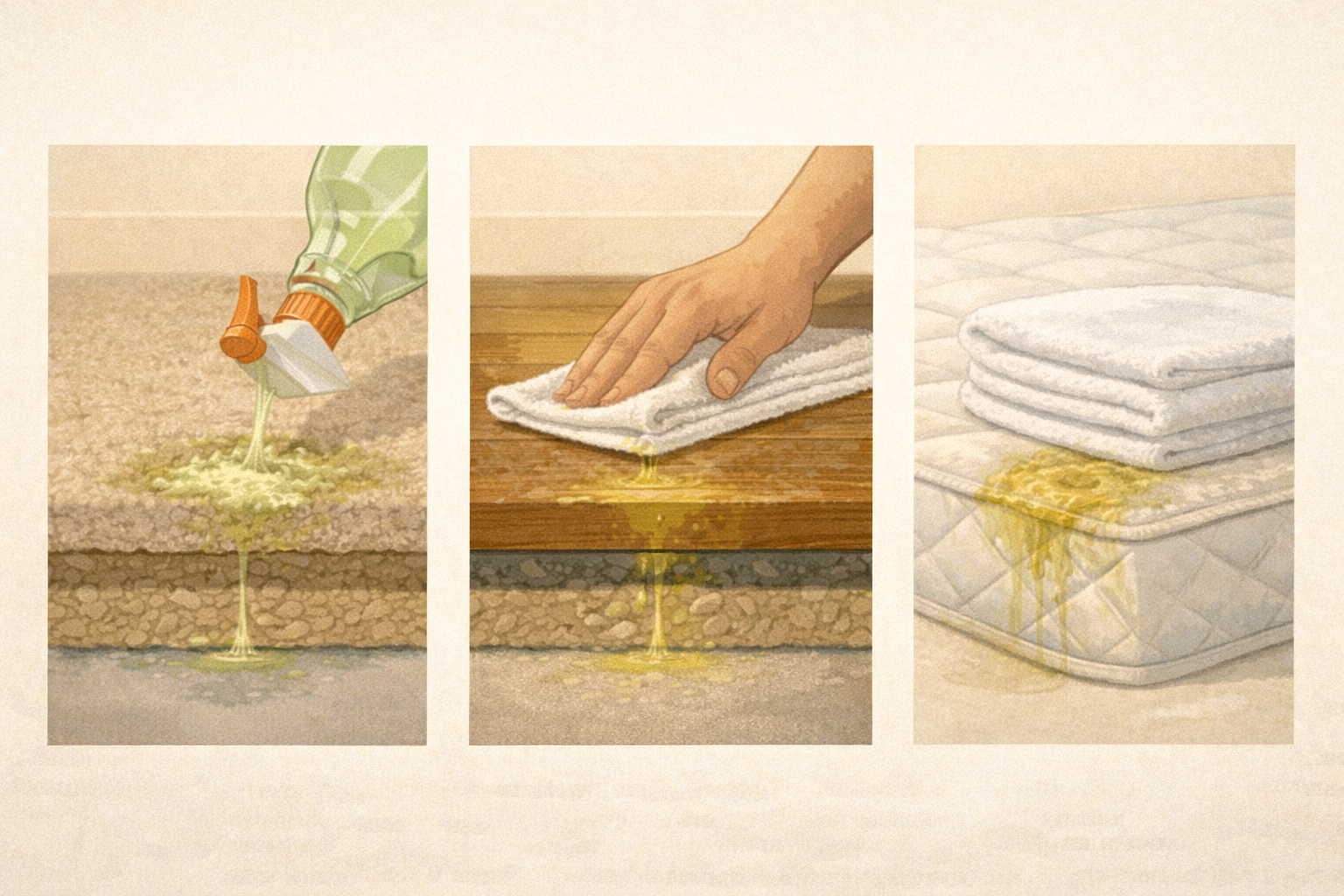
The application matters as much as the product. Most people spray enzymatic cleaner on a stain and wipe it up. That is not enough. The cleaner must reach the same depth the urine reached. On carpet, that means soaking through the fibers into the padding. On a mattress, that means saturating the foam. Spray-and-wipe does not get deep enough.
Blot up as much urine as possible
Use clean paper towels or old rags. Press down firmly and blot from the outside of the stain toward the center. Never rub or scrub. Rubbing pushes urine deeper into the fibers and spreads it wider. For dried stains, dampen the area with cold water first, then blot.
Soak the area with enzymatic cleaner
Pour the cleaner generously over the entire stain. Do not spray. The cleaner needs to penetrate to the same depth the urine reached. On carpet, that often means soaking through to the padding underneath. Use enough that the area is visibly wet, not just damp.
Wait at least 15 minutes
The enzymes need time to break down the uric acid. Fifteen minutes is the minimum. For older or set-in stains, leave the cleaner for 30 minutes or longer. Do not blot during this time. The cleaner is working.
Blot again and air dry
After the soak time, blot up excess moisture with clean towels. Then let the area air dry completely. Do not use a hair dryer, fan heater, or steam cleaner. Heat interferes with the enzymatic reaction and can set any remaining stain. Natural air drying gives the enzymes the time they need to finish the job.
Repeat if needed
Old stains or areas with multiple layers of urine often need two or three applications. If you can still smell anything after the first treatment dries completely, repeat the full process. Each application breaks down more uric acid.

Surface-by-surface guide
The core method is the same everywhere: blot, soak with enzymatic cleaner, wait, air dry. But each surface has quirks that change how you apply it.
Carpet
Carpet is the hardest surface to clean because urine soaks through the fibers into the padding and sometimes into the subfloor below. Blot first, then pour enzymatic cleaner until the area is saturated. The cleaner needs to reach the padding. Cover with a damp towel and leave for at least 30 minutes. Blot and air dry. For old stains that have soaked through to the subfloor, you may need to pull back the carpet and treat the padding and subfloor separately. If the padding is heavily soaked, replacing it is often more effective than trying to save it.
Hardwood floors
Sealed hardwood is easier to clean than carpet because the urine sits on the surface longer before penetrating. Wipe up fresh urine immediately, then apply enzymatic cleaner with a cloth. Do not pour cleaner onto hardwood. Too much moisture causes warping and discoloration. Apply a thin layer, let it sit for 10 minutes, wipe clean, and let dry completely before reapplying. For stains that have soaked into unsealed wood, the finish may need to be sanded and refinished after treatment.
Mattress
Blot as much urine as possible with towels. Spray enzymatic cleaner generously and let it sit for 15 minutes. Blot again and layer clean dry towels over the wet area. Replace the towels daily until the mattress is fully dry. Expect to need two or three applications. Once the mattress is clean and dry, put a waterproof mattress protector on it. If the mattress has been soaked repeatedly over weeks or months, replacement may be more practical than treatment.
Upholstery and couch cushions
Remove cushion covers and wash them if the fabric is machine-washable. For the foam inside, the cleaner needs to penetrate deep. Some people use a large syringe or turkey baster to inject enzymatic cleaner into the center of the foam. Treat wooden furniture frames separately by wiping with a cloth dampened with enzymatic cleaner. After treatment, consider using washable waterproof covers until you are confident the cat has stopped marking.
Clothing and bedding
Rinse the item in cold water first. Never use hot water. Heat sets the proteins in cat urine and locks in the odor permanently. Wash with your normal detergent plus one cup of baking soda or a quarter cup of white vinegar. If the smell persists after washing, soak the item in enzymatic cleaner for an hour, then wash again. Air dry only. Do not put it in the dryer until the smell is completely gone.
Concrete and subfloor
Concrete is porous and absorbs urine deeply. This is the surface most likely to need multiple treatments. Apply enzymatic cleaner liberally and let it soak for at least an hour. Repeat two or three times over several days. After the final treatment, consider sealing the concrete with a commercial concrete sealer to lock in any remaining trace odor. This is a common issue under removed carpet in homes with a history of cat accidents.
Mistakes that make the smell worse
Some of the most common cleanup methods actively make cat urine smell harder to remove. If you have tried cleaning a spot and the smell got worse, one of these is probably the reason.
Using ammonia-based cleaners. Cat urine naturally contains ammonia. When you clean a spot with an ammonia product, the area smells even more like a urine marking zone to the cat. Dr. Bruce Kornreich of the Cornell Feline Health Center has noted that ammonia-based cleaners encourage cats to re-mark the same spot.
Using a steam cleaner. Heat bonds the proteins in cat urine to the surface fibers. A steam cleaner essentially cooks the stain into the carpet or upholstery. What was a surface stain becomes a permanent part of the fabric. This is one of the most common and most damaging mistakes.
Using hot water. Same problem as the steam cleaner, smaller scale. Always use cold water when rinsing or blotting cat urine. Cold water lifts the urine without bonding it deeper.
Spraying instead of soaking. A light mist of enzymatic cleaner on top of a carpet stain only treats the surface. The urine is in the padding. The cleaner has to reach the padding to work. Pour, do not spray.
Not waiting long enough. Enzymatic cleaners need time. Spraying and wiping after two minutes does almost nothing. Fifteen minutes is the minimum. Thirty minutes for old stains.
Using expired cleaner. The enzymes in enzymatic cleaners are living bacterial cultures. They degrade over time, especially after the bottle has been opened. Check the expiration date. If the bottle has been open for more than a year, replace it.

When cleaning is not enough
Sometimes the right answer is replacement, not more cleaning.
Replace carpet padding if it has been soaked through multiple times. Carpet fibers can usually be salvaged with enzymatic treatment. The padding underneath absorbs far more urine and is much harder to fully treat. New padding costs far less than repeated professional cleaning attempts.
Replace the subfloor section if urine has soaked through the padding into plywood or particle board. Particle board especially absorbs urine permanently. You can seal it with a shellac-based primer like BIN to lock in the odor, but replacement is more reliable if the section is small enough.
Replace the mattress if it has been soaked repeatedly over an extended period. A single accident on a mattress is usually treatable. Months of repeated soaking is not. At that point, the foam core is saturated at a depth enzymatic cleaner cannot consistently reach.
Call a professional if you have treated every visible spot and the smell persists. Professional cleaners who specialize in pet urine have extraction equipment that can pull cleaner and urine residue from deep within carpet padding and subfloor. Ask specifically about pet urine experience. General carpet cleaning and pet urine removal are different skills.
The goal is not perfection on the first pass. It is breaking the cycle. Clean every spot you can find, replace what is too far gone, and address why the cat is not using the litter box.
Why it keeps happening
Cleaning solves the symptom. Preventing future accidents solves the problem. If a cat pees outside the litter box once, there is usually a reason.
The litter box is not clean enough. This is the most common cause. Cats are more sensitive to litter box odor than humans. Scooping daily and changing litter completely every one to two weeks prevents most litter box avoidance.
Wrong litter type or depth. Some cats refuse certain textures. Fine clay clumping litter is the most widely accepted type. Most cats prefer two to three inches of litter depth. If you recently switched brands and the accidents started, switch back.
Not enough boxes. The general guideline is one box per cat, plus one. Two cats should have three boxes. This is not a marketing trick to sell more litter. Cats avoid boxes that smell like another cat.
Box location problems. Boxes near loud appliances, in high-traffic areas, or in corners where a cat feels trapped can all cause avoidance. Cats want a quiet, accessible spot where they can see an escape route.
Medical issues. Urinary tract infections, kidney disease, and diabetes can all cause a cat to urinate outside the box. If the behavior is new and sudden, a vet visit should be the first step, not a cleaning guide. This is especially true for older cats or cats that have always used the box reliably until now.
A litter box that is clean, filled with the right litter, placed in a calm spot, and available in the right quantity eliminates most of the behavioral reasons cats avoid it. Getting the litter right is the foundation.
FAQ
1Does vinegar get rid of cat pee smell?
Temporarily. Vinegar neutralizes the alkaline salts in dried urine and removes the water-soluble components. It does not break down uric acid, which is the compound responsible for the smell returning after a few days or after humidity exposure. Vinegar is a reasonable first step, but enzymatic cleaner is required for permanent odor removal.
2How long does cat pee smell last?
The uric acid in cat urine has a half-life of six years. Without enzymatic treatment, the smell can persist for years and reactivate whenever humidity levels rise. With proper enzymatic treatment, the smell is permanently eliminated once the cleaner has fully dried and completed its chemical reaction.
3Can you use bleach on cat pee?
No. Bleach reacts with the ammonia in cat urine and can produce toxic chloramine gas. Beyond the safety risk, bleach does not break down uric acid, so the smell will return. Use an enzymatic cleaner instead.
4Why does my house still smell like cat pee after cleaning?
The most likely reason is that the cleaning method you used did not break down the uric acid crystals. Standard cleaners remove the surface-level components but leave uric acid intact. The second most common reason is missed spots. Use a UV blacklight in a dark room to check for stains you may have overlooked, especially behind furniture, along baseboards, and under beds.
5Does baking soda remove cat urine odor?
Baking soda absorbs some surface odor and is useful as an additive when washing clothes or bedding. On its own, it does not break down uric acid. It can help reduce the immediate smell while you wait for enzymatic cleaner to work, but it is not a substitute for enzymatic treatment.
6Why does my cat keep peeing in the same spot?
Cats can detect uric acid residue at concentrations far below the human threshold. Even if a spot smells clean to you, your cat may still detect the old urine and treat the area as an established marking zone. The only way to break this cycle is to fully eliminate the uric acid with an enzymatic cleaner. If the behavior continues after thorough cleaning, consult your vet to rule out medical causes.
Find the right litter for your home
The right litter prevents most odor and cleanup problems before they start. These guides cover the tradeoffs that matter.