How to Get Your Cat to Use a Scratching Post
If your cat ignores the scratching post and keeps going for the couch, the problem is almost never the cat. It is the post's material, location, or stability. Cats scratch instinctively — they need to scratch. The question is whether the post you bought gives them what they actually want. Here is how to fix the common mistakes and redirect the behavior without punishment.
Time to read
7 min
Sections
6 + FAQ
When you buy through our links, we may earn a commission at no extra cost to you. That never changes what we recommend.
Why cats scratch and what they are looking for
Cats scratch for three reasons, and understanding them tells you what the scratching post needs to provide.
Claw maintenance. Scratching removes the dead outer sheath of the claw, exposing the sharp new growth underneath. This is not optional behavior. Cats that do not scratch develop overgrown, layered claws that can curl into the paw pad. Every cat needs a scratching surface, period.
Territory marking. Cat paws have scent glands between the pads. When a cat scratches a surface, it deposits scent markers that tell other animals this territory is claimed. This is why cats return to the same scratching spots over and over. The scent draws them back. A brand-new scratching post has no scent, which is one reason cats ignore it at first.
Stretching. Cats anchor their claws into a surface and pull their body against it to stretch the muscles of the shoulders, legs, and spine. A scratching surface that is too short, too wobbly, or too soft does not provide enough resistance for this stretch. The cat moves to something that does — usually the arm of your couch, which is tall, stable, and textured.
A good scratching post satisfies all three needs: hard enough for claw maintenance, in a location where marking matters, and tall and stable enough for a full-body stretch.
Placement matters more than the post itself
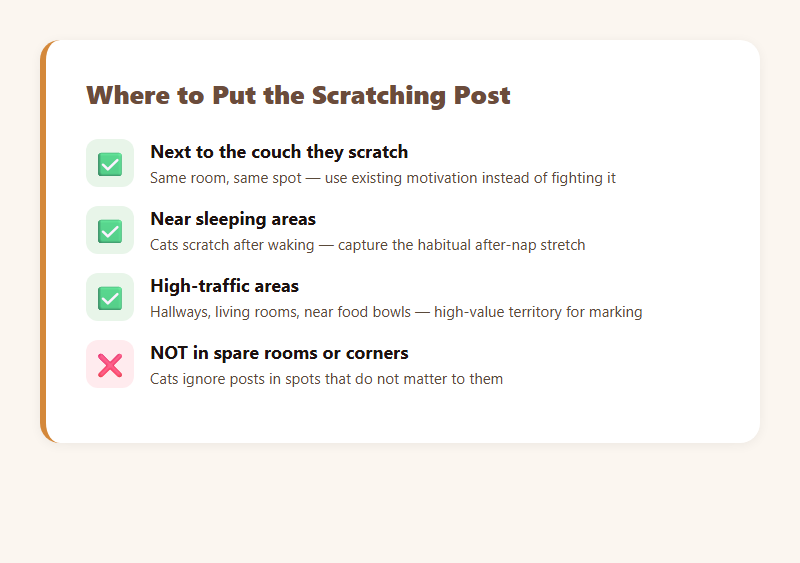
The most common reason a cat ignores a scratching post is location. People put scratching posts in out-of-the-way corners, spare rooms, or tucked behind furniture because they do not want the post in the middle of the living space. Cats ignore posts in those spots because those spots do not matter to them.
Put the post where the cat already scratches. If the cat scratches the side of the couch, put the post next to the couch. If the cat scratches the door frame in the hallway, put a post in the hallway. Cats scratch in high-traffic areas and territorial boundaries because those are the locations where scent marking has social value.
Near sleeping spots. Cats often scratch immediately after waking up as part of their stretching routine. A post within a few feet of the cat's favorite sleeping spot catches this behavior naturally.
Near entrances and transitions. Doorways, hallway intersections, and the path between rooms are territorial boundaries. A scratching post at a transition point between rooms aligns with the cat's instinct to mark territory at borders.
Once the cat is regularly using the post, you can gradually move it a few inches per day toward a less conspicuous location. Moving it all at once breaks the habit. Slow migration over a week or two keeps the behavior intact while relocating the post to where you actually want it.
Using catnip and positive reinforcement
Catnip can accelerate the process of getting a cat interested in a new scratching post, but it works differently than most people think.
Rub dried catnip into the sisal or fabric. Do not just sprinkle it on top. Work it into the fibers so the cat smells it when it approaches and investigates with its nose close to the surface. The goal is to draw the cat to the post and encourage physical contact with the scratching surface. Once the cat touches the surface and feels the texture, scratching instinct often takes over.
Not all cats respond to catnip. Roughly 30% of cats are genetically indifferent to it. If your cat ignores catnip, silvervine or Tatarian honeysuckle are alternative attractants that trigger similar behavior in some catnip-resistant cats.
Positive reinforcement beats punishment every time. When the cat scratches the post, give a treat immediately. Not five minutes later — immediately. The association between scratching the post and receiving a reward must be instant for the cat to connect the two events. Do this consistently for 1-2 weeks and the behavior becomes habitual.
Never punish a cat for scratching furniture. Punishment creates anxiety, which increases stress-scratching, which makes the problem worse. The cat does not understand why it is being punished for a behavior it is biologically compelled to perform. Redirect, reward, repeat.
Redirecting scratching away from furniture
If your cat is already scratching furniture, the strategy has two parts: make the furniture less attractive and make the post more attractive. Both need to happen simultaneously.
Cover the scratched furniture surface temporarily
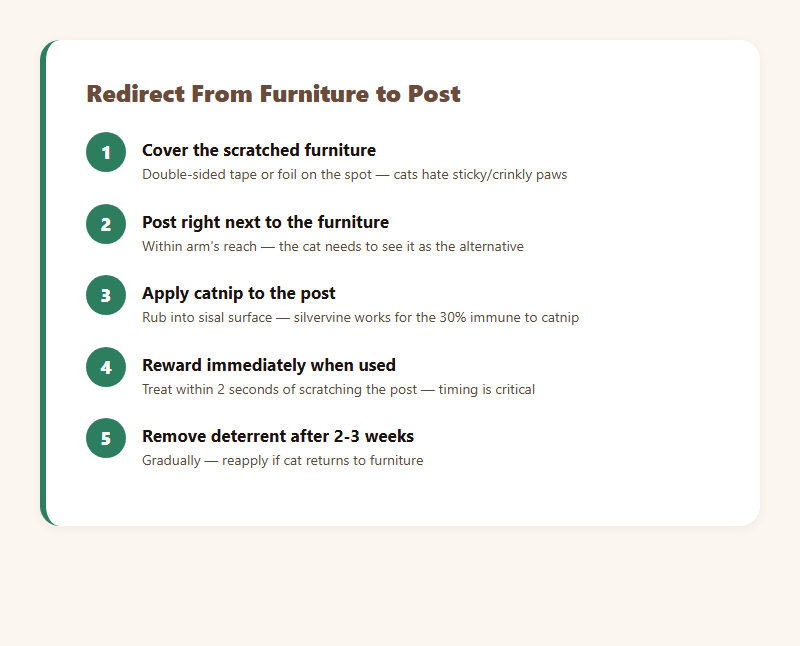
Apply double-sided tape (Sticky Paws brand is made for this), aluminum foil, or a plastic furniture protector over the area the cat scratches. Cats dislike sticky surfaces on their paws and the crinkle texture of foil. This does not stop the scratching instinct — it makes the cat look for a better surface.
Place the scratching post directly next to the covered furniture
The post must be within arm's reach of the spot the cat was scratching. The cat approaches its usual scratching spot, finds the surface unappealing, and turns to the nearest alternative. If the post is across the room, the cat will find a different piece of furniture instead.
Apply catnip or attractant spray to the post
Rub dried catnip into the sisal or spray a commercial scratching-post attractant on the surface. This increases the chance the cat investigates and engages with the post on the first encounter.
Reward the cat immediately when it uses the post
The first time the cat scratches the post, give a treat within 2 seconds. Repeat every time for the first week. This positive reinforcement builds a preference for the post over the furniture. Timing matters — delayed rewards do not create the association.
Remove the furniture covering gradually after 2-3 weeks
Once the cat is using the post consistently, remove the tape or foil from the furniture. If the cat returns to the furniture, re-cover and continue the redirect process. Most cats stay with the post once the habit is established, but some need a second round.
The right material: sisal, cardboard, and carpet compared
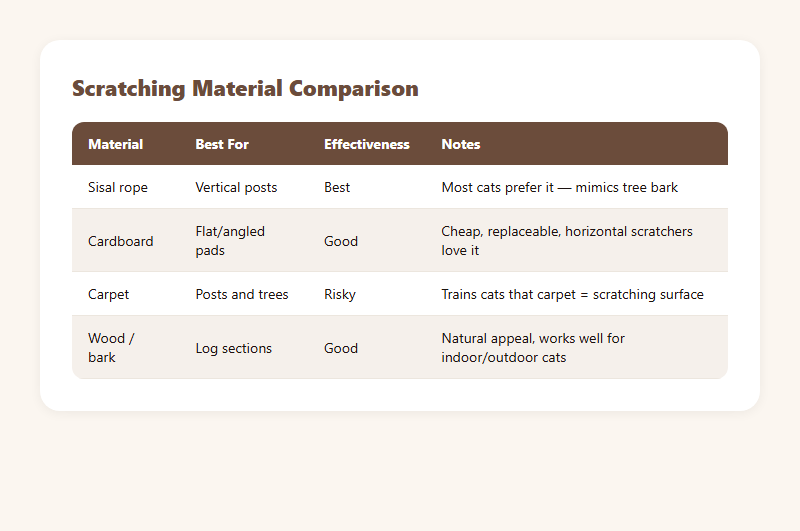
The material of the scratching surface determines whether a cat uses the post or ignores it. Different cats prefer different textures, and the wrong material is the second most common reason (after bad placement) that posts get ignored.
Sisal rope is the most popular material and the one most cats prefer. The coarse fiber provides strong resistance, which satisfies the claw-maintenance and stretching needs. Sisal holds up to heavy use — 12-18 months of daily scratching before it frays enough to need replacement. Sisal also holds scent well, which reinforces the territorial marking behavior.
Sisal fabric (flat woven, not rope) is preferred by some cats over rope because the flat surface gives them a broader scratching area per stroke. Sisal fabric wears faster than rope but feels different underfoot. If your cat scratches flat surfaces (rugs, carpet) more than vertical surfaces, try a sisal fabric scratcher.
Cardboard scratchers are cheap, replaceable, and surprisingly effective. Many cats that ignore sisal posts will use a corrugated cardboard scratcher immediately because the texture is softer and the shredding sensation feels different. Cardboard wears out in 2-4 weeks of daily use, but at a few dollars per replacement, the cost is manageable. Cardboard is also the best material for testing whether a cat will scratch in a given location before committing to a permanent post.
Carpet-wrapped posts are the weakest option. The carpet loop texture catches claws awkwardly, and cats that learn to scratch carpet-wrapped posts often transfer the behavior to actual room carpet. If your cat already scratches your carpet, a carpet-wrapped post reinforces the problem instead of solving it.
Wood and bark are natural scratching surfaces that outdoor cats use instinctively. Indoor scratching posts wrapped in natural bark or made from driftwood appeal to some cats that reject synthetic textures. These are niche products, but worth trying if a cat ignores both sisal and cardboard.
When to replace a scratching post
A worn scratching post is not a failed scratching post. Cats often prefer posts that are already broken in because the worn surface holds more of their scent. Replacing a heavily-used post too early can reset the training process.
Replace sisal rope posts when the rope is shredded to the point where the underlying post is exposed. If you can see the cardboard or wood core through large gaps in the sisal wrap, the scratching surface is no longer functional. Until that point, leave it. A frayed post that still has intact sisal is a post the cat has claimed.
Replace cardboard scratchers when the corrugation is flattened. The cat needs the ridges to hook its claws into. Once the surface is smooth and compressed, it is no longer useful. This usually happens within 2-4 weeks of daily use.
Do not throw away the old post until the cat is using the new one. Place the new post next to the old one. Rub some of the old sisal fibers onto the new post to transfer scent. Give the cat a week to transition. Some cats switch immediately. Others need the scent bridge.
If the post wobbles, fix or replace it immediately. A wobbly post is a post cats stop using. Check the base bolts and tighten them. If the base itself is cracked or warped, replace the post. Stability is not negotiable — cats will not scratch a surface that moves away from them.
FAQ
1Why does my cat scratch the couch instead of the scratching post?
The most common reason is location. If the post is in a low-traffic corner and the couch is in the main living area, the couch wins because cats scratch in socially important spots. Move the post next to the couch. The second most common reason is material — carpet-wrapped posts feel different from sisal, and some cats reject the texture. Try sisal rope or cardboard.
2Does catnip on a scratching post really work?
For roughly 70% of cats, yes. Rub dried catnip into the sisal fibers to draw the cat to the post. Once the cat physically contacts the surface, scratching instinct often takes over. About 30% of cats do not respond to catnip due to genetics. For those cats, silvervine or Tatarian honeysuckle are alternatives worth trying.
3How long does it take to train a cat to use a scratching post?
Most cats begin using a well-placed, catnip-treated scratching post within 1-2 weeks of consistent positive reinforcement. The combination of correct placement, attractive material, and immediate treat rewards after each use builds the habit. Some cats switch in a day. Others need the full two weeks. Patience and consistency matter more than the specific post.
4Should I get a vertical or horizontal scratching post?
Watch where your cat scratches now. If it scratches the side of the couch or a door frame, it prefers vertical surfaces — get a tall post. If it scratches the carpet or a rug, it prefers horizontal surfaces — get a flat scratcher or angled board. Some cats scratch both, in which case having one of each covers both preferences.
5How tall should a scratching post be?
Tall enough for the cat to fully extend its body while stretching against the surface. For most adult cats, that means at least 30 inches. For large breeds, 36 inches or taller. A post that is too short does not allow a full stretch, and the cat will find something taller — usually your furniture.
Find the right litter for your home
The right litter prevents most odor and cleanup problems before they start. These guides cover the tradeoffs that matter.