How to Clean Cat Pee From Carpet
Fresh cat urine on carpet is fixable if you act within the first 10 minutes. Old stains that have soaked into the padding are harder but still treatable. Here is the full process from blotting to enzymatic treatment, plus what to do when the stain has reached the subfloor.
Time to read
7 min
Sections
6 + FAQ
When you buy through our links, we may earn a commission at no extra cost to you. That never changes what we recommend.
Immediate response: the first 10 minutes matter
Speed determines difficulty. Fresh urine that has not soaked through the carpet fibers into the padding is dramatically easier to treat than urine that has been sitting for hours or days. If you catch it within the first 10 minutes, you can often prevent the urine from reaching the padding at all.
Do not step on the wet area. Foot pressure pushes urine deeper into the carpet fibers and into the padding below. Do not spray anything yet. Your first job is to remove as much liquid as possible before applying any cleaner.
Blot up as much urine as possible
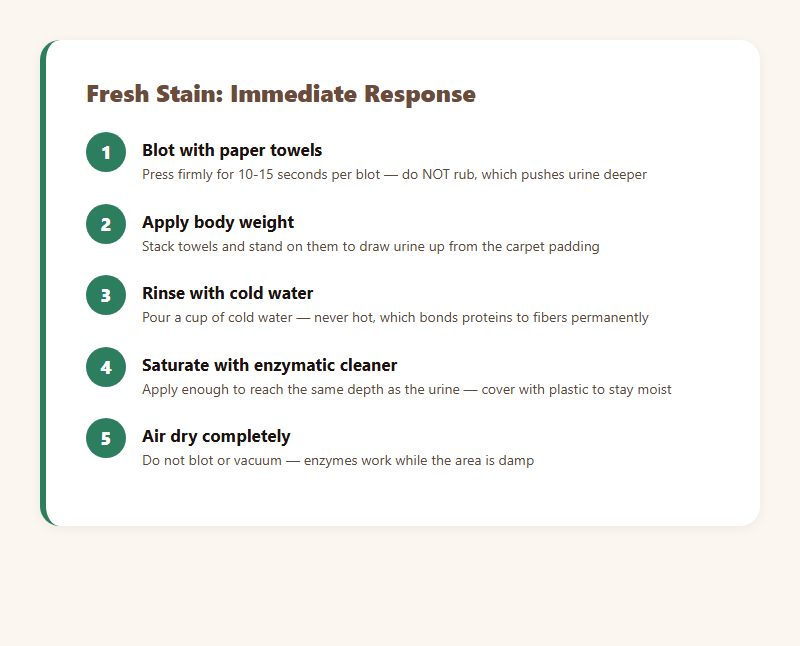
Stack three or four paper towels or a folded old rag on the wet spot. Press down firmly with your hands. Do not rub or scrub. Rubbing pushes the urine deeper and spreads it wider. Blot from the outside edges toward the center to contain the stain. Replace the towels when they are saturated. Keep blotting until the towels come up barely damp.
Rinse with cold water only
Pour a small amount of cold water onto the stain. Never use hot water. Heat bonds the proteins in cat urine to carpet fibers and locks in the odor permanently. Cold water dilutes the remaining urine without setting it. Blot the water up with fresh towels.
Apply enzymatic cleaner generously
Pour enzymatic cleaner over the entire stain area. Do not spray. The cleaner needs to reach the same depth the urine reached. For fresh stains caught early, the urine is likely still in the carpet fibers, so a generous pour across the surface is enough. Let the cleaner sit for at least 15 minutes. Do not blot during this time.
Blot and air dry
After 15 minutes, blot the excess cleaner with clean towels. Then let the area air dry completely. Do not use a hair dryer, heat lamp, or steam cleaner. Heat interferes with the enzymatic reaction. Natural drying at room temperature gives the enzymes time to break down the uric acid fully.
Why enzymatic cleaners are the only real solution
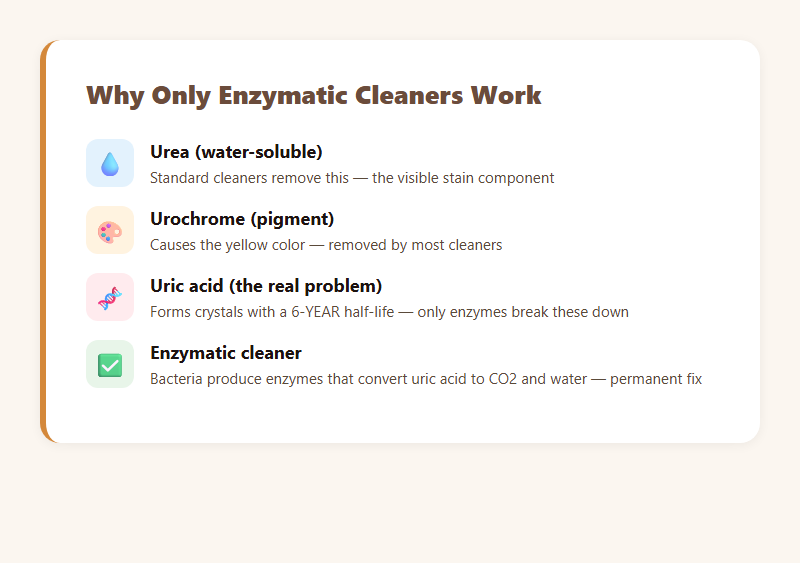
Cat urine contains uric acid, a compound that is not water-soluble. Standard household cleaners — dish soap, all-purpose spray, baking soda, vinegar, hydrogen peroxide — remove the water-soluble parts of cat urine. The urea, the urobilin, the surface stain. They make the carpet look and smell clean for a few days.
Then the humidity changes. The uric acid crystals that are still bonded to the carpet fibers reactivate. The smell comes back. You clean again. It comes back again. This cycle repeats because no standard cleaner breaks down uric acid.
Enzymatic cleaners contain bacterial cultures that produce specific enzymes to break uric acid into carbon dioxide and ammonia gas. Both evaporate. The uric acid is gone permanently. No more crystals, no more reactivation, no more phantom smell.
Products that work: Nature's Miracle, Rocco and Roxie Professional Strength, Angry Orange Enzymatic, Anti-Icky Poo, and Urine Off are all enzymatic formulas with consistent owner results. The brand matters less than two things: (1) the product is genuinely enzymatic, and (2) you use enough of it to reach the full depth of the stain.
Application is more important than brand. Most people spray a little cleaner on the surface and wipe it up. That treats the top half-inch of carpet fiber. On a stain that has soaked through to the padding, you need to pour enough cleaner to saturate through to the same depth. Spray-and-wipe does not reach the padding.
Treating old or dried stains you just discovered
Old stains are harder because the urine has had time to soak deep into the carpet, through the padding, and possibly into the subfloor. The uric acid crystals are fully bonded. The good news is that enzymatic cleaners still work on old stains. They just need more time and more product.
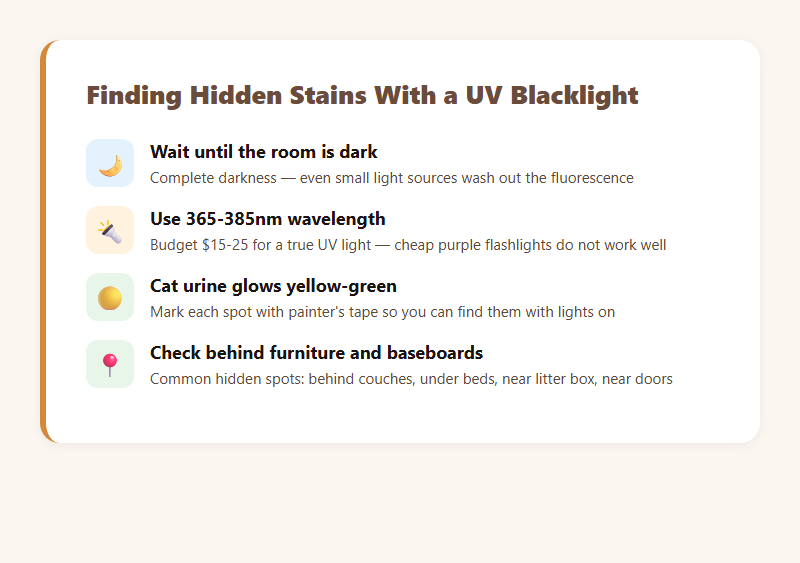
Step 1: Locate every old stain. Dried urine is often invisible under normal light. Use a UV blacklight flashlight in a completely dark room. Cat urine fluoresces bright yellow-green under UV light. Check along baseboards, behind furniture, and in corners. Mark each spot with painter's tape before turning the lights on.
Step 2: Rehydrate the stain. Pour a small amount of cold water onto the dried stain and let it sit for 5 minutes. This loosens the dried urine and opens the carpet fibers so the enzymatic cleaner can penetrate.
Step 3: Saturate with enzymatic cleaner. Pour generously. For old stains, you need enough cleaner to soak through the carpet and into the padding. This is not a light application. The entire stain area should be visibly wet through the carpet.
Step 4: Cover and wait. Place a damp towel or plastic wrap over the treated area to keep the cleaner from drying out. Enzymatic cleaners need moisture to keep working. Leave it for at least 30 minutes. For stains that are weeks or months old, leaving the cleaner overnight produces better results.
Step 5: Blot, air dry, and repeat. After the soak period, blot up the excess and let the area air dry. If you still detect odor after the area is fully dry, repeat the full process. Old stains often need two or three applications because the uric acid is layered deeper.
Using a UV blacklight to find every stain
A UV blacklight flashlight costs under ten dollars and is the most useful tool you can own for cat urine cleanup. Here is how to use it effectively.
Wait until the room is completely dark. Close curtains, turn off all lights, block light from doorways. Even a small amount of ambient light reduces the contrast that makes stains visible under UV.
Scan slowly and systematically. Hold the flashlight 6 to 12 inches from the surface and move it in overlapping passes. Cat urine glows bright yellow-green under UV. Other organic stains may also fluoresce, but cat urine has a distinct bright color.
Check everywhere, not just the floor. Urine splashes. A cat urinating against a wall sprays the baseboard, the wall surface, and the floor. Check the base of walls, furniture legs, the outside of the litter box, shoes left near the box, and any fabric within range.
Mark stains with painter's tape. It is easy to lose track of exactly where stains are once the lights come back on. Put a small piece of tape next to each stain while you can still see it under UV.
Expect more stains than you thought. One visible accident usually means several more that you did not see. Cats that urinate outside the box tend to repeat the behavior, and each instance may have gone unnoticed until the smell built up. Finding five or ten stains when you expected one is common.
When the problem goes deeper: padding and subfloor
Carpet fibers are the surface layer. Underneath is carpet padding — a sponge-like material designed to absorb impact. It also absorbs urine extremely well. Underneath the padding is the subfloor, which is typically plywood or particle board.
Carpet padding. If urine has soaked through the carpet into the padding, enzymatic cleaner needs to reach the padding to work. Pour enough cleaner to saturate through the carpet. For heavily soaked areas, pull back the carpet edge and treat the padding directly. Padding that has been soaked repeatedly over weeks or months may not be recoverable. Replacement padding costs $3 to $8 per square yard and is easier and cheaper than repeated deep treatments.
Subfloor. Plywood subfloor can be treated with enzymatic cleaner if the saturation is not extreme. Pour cleaner directly on the plywood, let it soak for 30 to 60 minutes, and repeat two or three times over several days. After the final treatment, seal the plywood with a shellac-based primer like BIN or Kilz Original to lock in any trace odor before replacing the padding and carpet.
Particle board subfloor. Particle board absorbs moisture permanently and swells when wet. If cat urine has soaked into particle board, the section almost always needs to be cut out and replaced. Enzymatic treatment on deeply saturated particle board is unreliable because the board's structure has already been compromised by the moisture.
When to call a professional. If you have treated the carpet and the smell persists, the problem is in the padding or subfloor. Professional pet urine cleaners have extraction equipment that can pull cleaner and urine residue from deep within padding. Ask specifically about pet urine experience — general carpet cleaning and pet urine removal are different services.
Preventing future accidents on carpet
Cleaning solves today's stain. Preventing the next one solves the actual problem.
Keep the litter box clean. The most common reason cats urinate outside the box is that the box is not clean enough. Scoop daily. Do a full litter change on the schedule your litter type requires. A box that smells acceptable to you may already smell unacceptable to a cat.
Check the litter type and depth. Some cats refuse certain litter textures. Fine-grain clumping clay is the most broadly accepted type. Maintain 3 inches of depth for clumping litter. If you recently switched brands and the accidents started, switch back.
Provide enough boxes. One box per cat, plus one extra. Two cats should have three boxes. Cats avoid boxes that smell like another cat, and a single shared box in a multi-cat home is a common trigger for outside-the-box urination.
Rule out medical issues. Urinary tract infections, kidney disease, diabetes, and bladder stones can all cause a cat to urinate outside the box. If the behavior is sudden and new — especially in a cat that previously used the box reliably — a vet visit should come before another cleaning session.
Block access to the old stain. Even after enzymatic treatment, place a piece of furniture, a litter box, or a plastic mat over the spot for several weeks. This removes the location as a behavioral option while the enzymatic treatment fully cures.
FAQ
1Does enzymatic cleaner work better than regular carpet cleaner?
For cat urine, yes. Regular carpet cleaners remove the water-soluble components of urine but cannot break down uric acid, which is the compound that causes the smell to return days or weeks later. Enzymatic cleaners contain bacterial cultures that break uric acid into gases that evaporate permanently. For non-urine carpet stains, regular cleaner is fine. For cat urine specifically, enzymatic is the only reliable option.
2Why does the smell come back after I clean cat pee from carpet?
Uric acid. Standard cleaners remove the visible stain and the immediate odor, but uric acid crystals remain bonded to the carpet fibers. When humidity changes, those crystals reactivate and release odor again. The only way to stop the cycle is to use an enzymatic cleaner that breaks down the uric acid itself. Each application reduces the remaining uric acid. Old stains may need two or three treatments.
3Does vinegar and baking soda work on cat pee in carpet?
Temporarily. Vinegar neutralizes the alkaline salts in dried urine and baking soda absorbs surface odor. Together they remove the water-soluble parts of the stain and provide short-term odor relief. They do not break down uric acid. Within a few days to a week, especially after humidity exposure, the smell returns. Vinegar and baking soda are reasonable as a first step if you do not have enzymatic cleaner on hand, but they are not a permanent solution.
4Should I hire a professional carpet cleaner for cat pee?
If you have treated the carpet with enzymatic cleaner and the smell persists, the urine has likely soaked into the padding or subfloor. Professional pet urine cleaners have extraction equipment that reaches deeper than consumer products. Ask specifically for pet urine treatment, not general carpet cleaning. Standard hot-water extraction can actually set urine proteins with heat, making the problem worse.
5My cat keeps peeing on the same carpet spot. How do I stop it?
Cats return to spots where they can detect uric acid residue, even at concentrations far below human detection. First, treat the spot thoroughly with enzymatic cleaner until you cannot detect any smell even with your nose at carpet level. Then block access to the spot for at least two weeks using furniture, a plastic mat, or by placing a litter box directly over it. Address the root cause: check the litter box for cleanliness, ensure the litter type is right, and consult a vet if the behavior is new.
Find the right litter for your home
The right litter prevents most odor and cleanup problems before they start. These guides cover the tradeoffs that matter.