How Much Cat Litter to Use
The right amount of cat litter is 3 inches of depth for clumping litter, 2 inches for non-clumping. Here is why those numbers work, what happens when you get it wrong, and how to keep the level right without overfilling or running low.
Time to read
6 min
Sections
6 + FAQ
When you buy through our links, we may earn a commission at no extra cost to you. That never changes what we recommend.
How much cat litter to put in the box
The answer depends on the litter type, but the range is narrow.
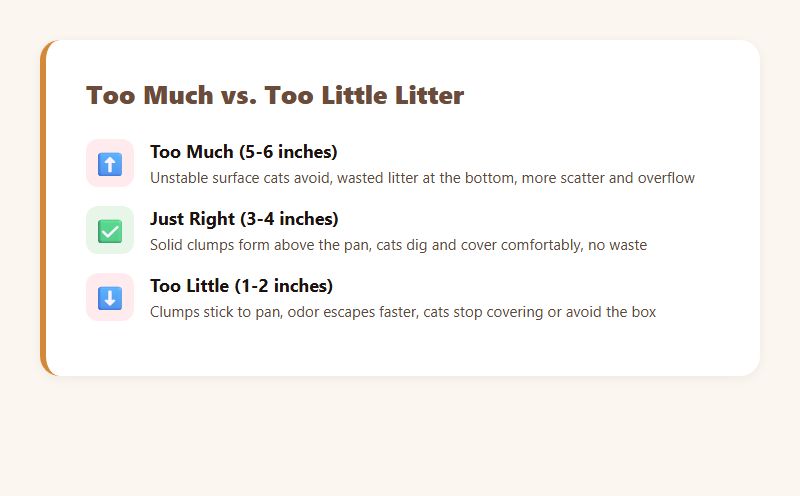
Clumping clay litter: 3 to 4 inches. Clumping litter needs enough depth for urine to form a solid clump before it reaches the bottom of the box. Below 3 inches, clumps hit the pan and stick. Above 4 inches, the surface becomes unstable and cats may avoid the box.
Non-clumping litter: 2 to 3 inches. Non-clumping formulas absorb moisture without forming clumps, so less depth is needed. The litter saturates evenly, and deeper fill just wastes product.
Crystal or silica litter: 1.5 to 2 inches. Silica gel crystals absorb a large volume of liquid relative to their size. They do not clump, so you need less. Overfilling creates an uneven surface that cats dislike.
Pellet litter (pine, paper, grass): 2 to 3 inches. Pellets expand when wet. Starting with too much means the pellets grow into a mound that overflows the box.
A simple test: push a finger straight down into the litter. If your fingertip touches the box bottom before reaching your second knuckle, there is not enough. If litter reaches past your second knuckle, there is probably too much.
What happens when you use too much
More litter feels like a safe choice. The logic is that a deeper box should trap more odor and require fewer full changes. In practice, overfilling creates three problems.
Problem 1: Unstable surface. Cats prefer a flat, firm surface to dig in. When the litter is 5 or 6 inches deep, the surface shifts under their paws like soft sand. Some cats respond by avoiding the box entirely. Others perch on the edge and go over the side.
Problem 2: Wasted litter. Cats dig to the depth they need, usually 1 to 2 inches. Extra litter below that depth never gets used and never gets scooped. It just sits there absorbing ambient moisture and eventually contributing to odor from the bottom of the box.
Problem 3: Overflow and scatter. More litter in the box means more litter available to be kicked out. Cats that dig vigorously will scatter the excess onto the floor, which defeats the purpose of a contained litter area. This is especially true for top-entry boxes where the cat launches litter upward during digging.
What happens when you use too little
Under-filling is the more common problem and the one that causes real behavioral issues.
Clumps stick to the pan. Without enough depth, urine reaches the box bottom before a clump can fully form. The result is a flat, stuck layer of wet clay that is hard to scoop and impossible to remove without scraping. The stuck residue smells, and no amount of scooping fixes it until you do a full box change.
Odor escapes faster. A shallow litter bed has less material to absorb and contain ammonia between scoops. The smell hits the room sooner, especially in warmer or more humid rooms.
Cats stop covering. Cats instinctively bury their waste. If the litter is too shallow to cover properly, some cats give up and leave waste exposed. Others decide the box is unacceptable and find a different spot. That spot is usually your carpet, your laundry, or behind the couch.
The fix is straightforward. If your cat is not covering consistently, add half an inch of litter and check again after a day or two. The threshold is usually obvious once the depth is right.
How to top off without overfilling
Topping off is the routine that keeps the box at the right level between full changes. Here is how to do it without gradually overfilling.
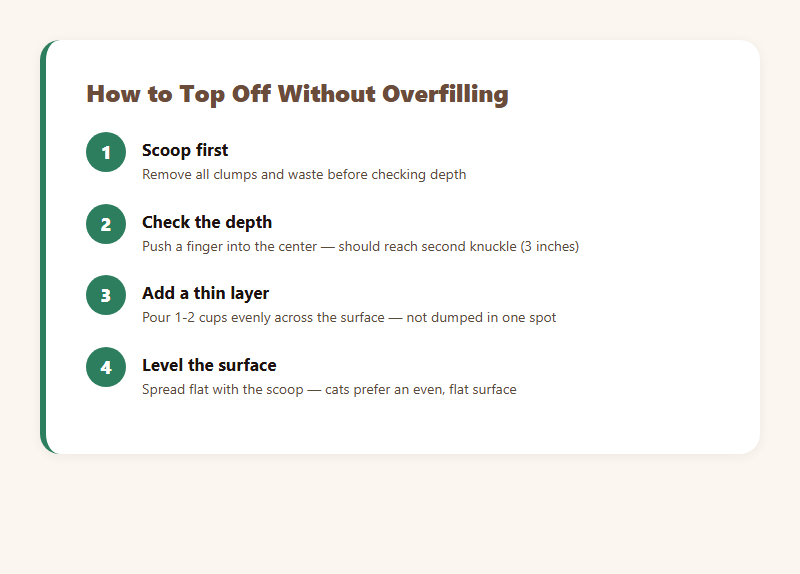
Step 1: Scoop first. Always scoop before topping off. This removes spent litter and gives you an accurate read on the current depth.
Step 2: Check depth. After scooping, push a finger or a ruler into the litter at the center of the box. If the depth is below 3 inches for clumping or 2 inches for non-clumping, add litter.
Step 3: Add a thin layer. Pour litter in a slow, even layer across the surface. A cup or two is usually enough for a single box. Do not dump a large amount into one spot.
Step 4: Level the surface. Spread the new litter with the scoop so the depth is even across the whole box. Cats prefer a flat surface. Mounds and valleys make the box less attractive.
Frequency: Most single-cat homes need to top off every 2 to 3 days with daily scooping. Multi-cat homes may need to top off daily. If you are topping off more than once a day, the box is too small or you need a different litter with better clumping efficiency.
Scoop the box first
Remove all clumps and solid waste before assessing the litter level. Scooping gives you an accurate read on current depth.
Check the depth
Push a finger or ruler into the center of the litter. If it is below 3 inches for clumping or 2 inches for non-clumping, it is time to add more.
Add a thin, even layer
Pour 1-2 cups of fresh litter in a slow, even layer across the surface. Do not dump it in one spot.
Level the surface
Spread the new litter flat with the scoop. Cats prefer a flat surface. Mounds and valleys make the box less inviting.
How much cat litter you actually go through per month
Most guides give you a number and move on. Here is a more honest breakdown based on typical scooping and replacement patterns.
One cat, clumping clay, daily scooping: 7 to 10 pounds per month. A 40-pound bag of Dr. Elsey's Ultra lasts 4 to 5 months at this rate. A 16-pound bag of BoxiePro lasts about 6 to 7 weeks.
Two cats, clumping clay, daily scooping: 15 to 22 pounds per month. Consumption does not just double because the second cat uses litter more efficiently in a shared box. But the topping-off frequency increases.
Three cats, clumping clay, daily scooping: 25 to 35 pounds per month. At this volume, the cost-per-pound math in our multi-cat litter guide becomes critical. The difference between $0.52/lb and $1.50/lb is $25-35 per month.
Crystal or silica litter: Roughly half the weight of clay per month, because the crystals absorb more per unit. PrettyLitter advertises one 8-pound bag per cat per month. Owner reports mostly confirm this.
Pellet litter: Lower weight per month because pellets expand as they absorb. A 20-pound bag of Feline Pine lasts roughly 4-6 weeks for one cat.
These are averages. Heavy diggers use more. Cats that spray the sides use more. Automatic boxes use more because they cycle more frequently. Track your first few bags to find your household's real number.
Depth and usage by litter type
Every litter type has a different optimal depth and consumption rate. Here is the quick reference.
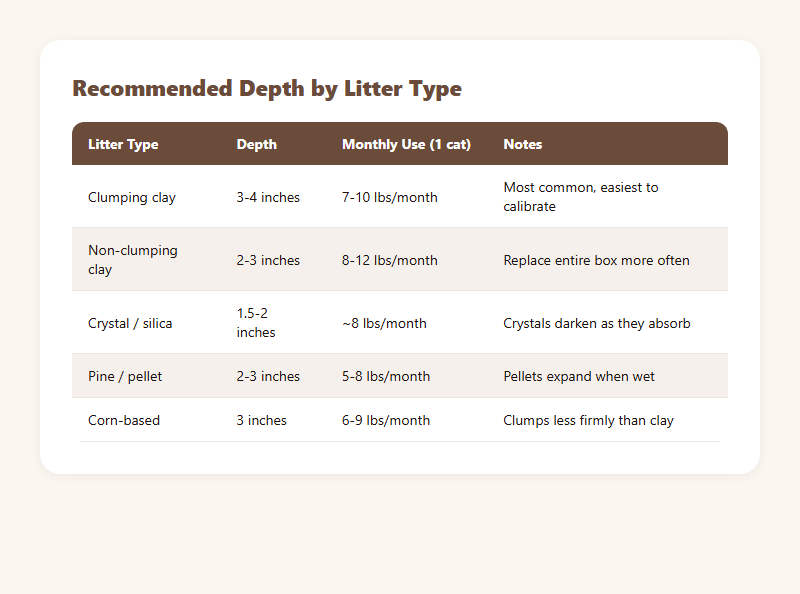
Clumping clay (Dr. Elsey's, ARM & HAMMER, Tidy Cats): 3-4 inches. Uses 7-10 lbs/month per cat. The most common type and the easiest to calibrate because the clumps give you visible feedback on how the litter is performing.
Non-clumping clay (traditional litter): 2-3 inches. Uses slightly more per month because you replace the entire box more often instead of scooping clumps. Less common for indoor cats now that clumping formulas dominate.
Silica crystal (PrettyLitter, Fresh Step Crystals): 1.5-2 inches. Uses roughly 8 lbs/month per cat. The crystals change color or darken as they absorb, so you can visually tell when the box needs a full swap.
Natural pellet (Feline Pine, SmartCat Grass, Naturally Fresh): 2-3 inches. Uses 5-8 lbs/month per cat. Pellets expand as they absorb, so the litter level rises slightly over the first few days. Start at the lower end and adjust.
Corn-based (World's Best, Tuft & Paw): 3 inches. Uses 6-9 lbs/month per cat. Corn clumps less firmly than clay, so maintain the full 3-inch depth to prevent clumps from breaking at the bottom.
FAQ
1How deep should cat litter be?
3 to 4 inches for clumping clay litter. 2 to 3 inches for non-clumping. 1.5 to 2 inches for silica crystals. These depths give cats enough material to dig and cover while keeping clumps from hitting the box bottom.
2How often should I completely change cat litter?
Every 2 to 4 weeks for clumping litter with daily scooping. Every 1 to 2 weeks for non-clumping. Every 3 to 4 weeks for silica crystals. If the litter smells between scoops despite being at the right depth, the full-change interval is too long.
3Can I just keep adding litter instead of changing it?
No. Topping off maintains the depth between full changes, but it does not replace the full change. Litter at the bottom of the box absorbs moisture and odor over time even after scooping. Without a full dump and wash every 2 to 4 weeks, the box develops a baseline smell that no amount of fresh litter on top will fix.
4How much does cat litter cost per month?
For one cat using clumping clay with daily scooping: $4 to $15 per month depending on brand. Dr. Elsey's at $0.52/lb costs roughly $4-5/month. BoxiePro at $1.50/lb costs roughly $12-15/month. Crystal litter runs $25-30/month. Multi-cat homes scale proportionally — see our monthly estimates above.
5Do kittens need less litter?
Use the same depth guidelines but in a smaller box. Kittens use standard-depth litter but produce less waste, so a smaller box at 3 inches deep works well. Do not use a shallow layer in a large box — kittens still need enough depth to dig and cover.
Find the right litter for your home
The right litter prevents most odor and cleanup problems before they start. These guides cover the tradeoffs that matter.